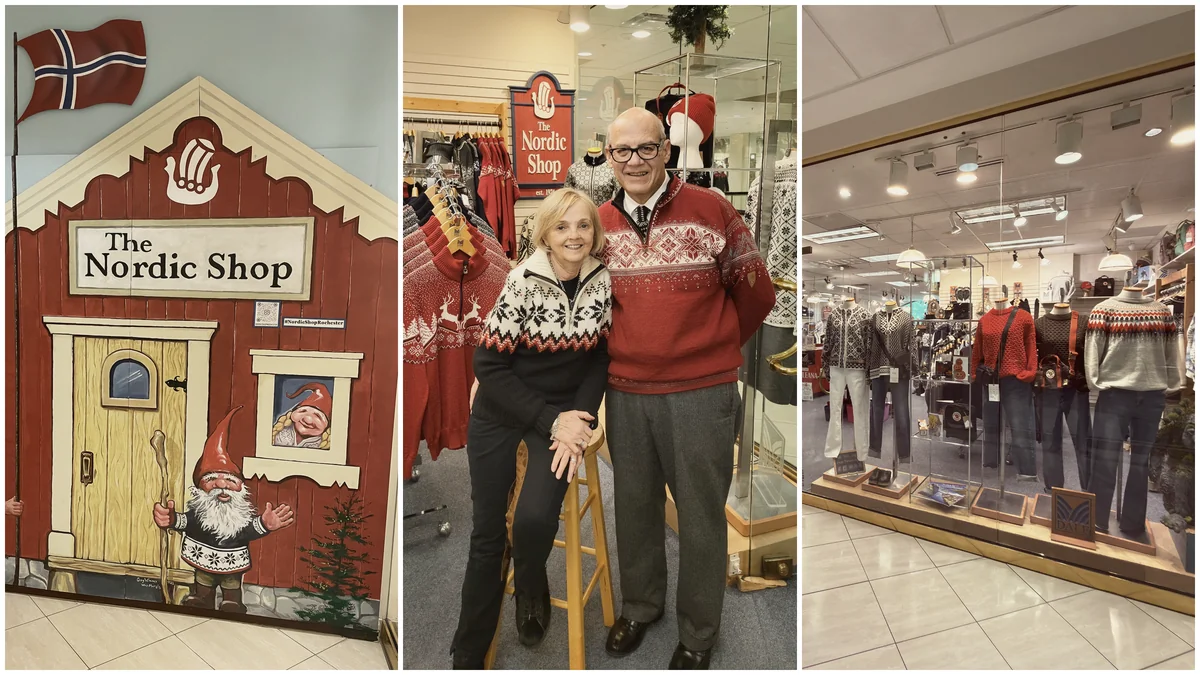
Walk through the skyway level of the Galleria Mall in downtown Rochester, Minnesota, and you will find a storefront mural that stretches the length of a whole shop front. During the holidays, families in matching pajamas line up in front of it for their Christmas photos. The mural covers the back room of The Nordic Shop, and many of the people posing outside have no idea that the couple behind that wall have been there for over fifty years.
Louise and Walter Hanson opened The Nordic Shop in 1974. They were both under twenty-five. They had no business background, no retail experience, and little money to spare. What they had was a passion for Nordic design, a semester abroad in Copenhagen, and a borrowed computer program that told them Rochester was a good place to try.
Neither of them had a background in anything related to what they are doing now. “We’ve learned everything kind of by the seat of our pants many times,” Walter says. “But we’ve learned it and we’ve moved on to where we’re recognized as being in the top of our niche.”
Two different paths to the same design
Louise grew up in a small town in southern Minnesota, in a family that was entirely Norwegian American. Her mother’s family settled near La Crosse, Wisconsin, in the 1840s. Her father’s family arrived in Minnesota a little later. She is at least third or fourth generation.
The household celebrated Christmas the Scandinavian way. There were traditional cookies, meatballs, and lutefisk at both Christmas and Thanksgiving. In the 1960s and 1970s, her parents began collecting Scandinavian design pieces and decorating their home with them. Louise grew to love those objects as her parents did.
Walter’s path was different. His family was more broadly American, though his grandparents came from Norway and Denmark, arriving in Chicago in the early 1900s. Like many immigrants of that era, they lost contact with relatives back home. Mail was rudimentary, people moved around on both sides of the Atlantic, and once an address changed, letters stopped arriving.
Walter discovered Scandinavian design not through family tradition but through architecture. He was studying for a master’s in architecture and architectural engineering at the University of Kansas when he encountered Scandinavian design as both an aesthetic statement and a way of life. It clicked.
The two met in college through a mutual friend who said, “You both love art and architecture, you should meet.” She was right. Louise was attending a small college outside St. Louis, and Walter worked at that college during his breaks from Kansas. When Louise had the opportunity to study abroad in Copenhagen during her junior year, the experience shaped everything that followed.
Copenhagen: where the idea was born
Louise’s semester in Copenhagen gave her direct access to the people and places behind the products she admired. Through her classes, she visited artists at major brands like Royal Copenhagen, Holmegaard, and independent weavers. She toured the Georg Jensen silver factory. She spent time in small workshops watching glassblowers and weavers at work.
What stayed with her was not just the beauty of the objects but the stories behind them. At Royal Copenhagen, she watched artists learn to hand-paint each plate, each cup, each design. Most of the porcelain was the iconic blue on white, but she also saw special pieces with floral patterns and 24-karat gold edges.
“I learned then to tell the story of a product,” Louise says. “Because I felt that if I was so interested in how things were made and the quality and the authenticity was there, that perhaps the customer who may want to purchase the product would also want to know those stories so they would understand how special it was and be able to collect it over time.”
Walter did not have a study abroad option. His architecture program’s big trip was from Lawrence, Kansas, to Kansas City to visit an architectural firm and an engineering firm. They were back in Lawrence by seven o’clock, as Walter recalls with a laugh.
But Copenhagen planted a seed. Louise and Walter talked about opening a store that would bring authentic, well-designed Scandinavian products to the United States. Not souvenirs. Not novelty items with “Kiss the cook, she’s Norwegian” printed on them. The real thing.
The first store: St. Charles, Missouri, 1972
Before Rochester, there was St. Charles. Louise graduated first. Walter still had two years to finish his master’s. In 1972, Louise opened a Scandinavian-style store on historic Main Street in St. Charles, Missouri, a small town outside St. Louis where Walter had worked since he was eight years old and Louise attended college. Main Street was a well-preserved historic district dating back to Lewis and Clark times, and it served as the backdrop for a number of films.
The store did fairly well, but it was limited. The area had very restricted hours. Weekend traffic was strong when the weather was nice, but weekdays were quiet. It was a proving ground, a way to test whether the concept worked before committing to something bigger.
Finding Rochester with a borrowed computer
When it came time to start something more permanent, Louise and Walter used the University of Kansas computer system to analyze potential locations. This was the early 1970s, when computers were large, rare, and required punch cards. They wrote a program, fed in their criteria, and Rochester, Minnesota came up as a top pick.
Rochester had a very stable economic base. It did not boom and bust. “It stays almost level, but a little bit up,” Walter says. “Which it has kind of for us all the way for 52 years.” That stability came largely from the Mayo Clinic, which brought a steady stream of visitors from around the world. Louise’s family was also somewhat nearby in southern Minnesota, which made the choice easier.
Walter had a job offer from a design firm in Chicago. He arranged to take a year off so Louise could try the Rochester store. They came up during his Christmas break in 1973, found an existing store to buy out, and negotiated a deal. The store had a year left on its lease. That gave them a runway.
It became clear very quickly that both of them enjoyed the work. Walter never went to Chicago. They have been in downtown Rochester ever since.
A plywood sign and 1,200 square feet
The original store was just under 1,200 square feet. That meant being extremely selective about what to carry. Louise’s concept from the beginning was to focus on high-design items and skip the novelty goods.
They did not spend money on a new sign. They took two lighted signs from the store they had bought out, cleaned the old paint off the plastic without damaging it, and screwed on cut-out plywood letters from the backside. The letters spelled “The Nordic Shop” alongside a Viking ship that Louise designed and later copyrighted. The signs worked as lighted signs at night and painted signs during the day.
The original Viking ship signs are probably still in their garden shed, though decades of Minnesota snow and rain took their toll. “They were cut out of plywood,” Walter says. “After the years of snow and rain and everything else that we have in Minnesota, they were fairly tired by the time we moved into the Galleria Mall.”
The store’s first location was in the Kahler Hotel complex, around the corner from the Mayo Clinic. In the 1970s, that was the most valuable commercial property in Rochester. They stayed there for about eighteen or nineteen years before moving to the Galleria Mall, where they have been ever since, gradually expanding into larger spaces.
Learning to tell the story
Royal Copenhagen porcelain was among the first products they carried. Louise had spent significant time at the Royal Copenhagen factory in Copenhagen, watching artists hand-paint each piece. The craftsmanship was something she wanted to share.
That became a foundational principle of the store. Every product had a story: how it was made, who made it, what tradition it came from. The idea was not just to sell a plate or a sweater but to help a customer understand what they were holding so they could build a collection over time.
They found their suppliers at trade shows and trade markets, where companies from around the world set up booths to reach the American market. Louise and Walter zeroed in on the Nordic brands they wanted: Royal Copenhagen from Denmark, Kosta Boda from Sweden, Porsgrunn porcelain from Norway. They made contacts, placed orders, and built relationships.
For suppliers they could not find at trade shows, they went to Scandinavia and showed up on doorsteps. They were twenty-four or twenty-five years old, introducing themselves as shopkeepers from Minnesota. Many of the people they met at those companies were junior staff who barely spoke English. Over the decades, those same people became CEOs and sales managers.
“So that is also where we’ve built up a long history with a lot of these companies,” Walter says. “It’s been a wonderful journey for us.”
Dale of Norway: a partnership built over decades
Among the earliest and most significant relationships was with Dale of Norway, the Norwegian sweater maker founded in 1879. Dale of Norway entered the US market after World War II, and The Nordic Shop started carrying their sweaters very early on.
The goal from day one was to carry the best of the best. In a 1,200-square-foot store, there was no room for anything less. Louise and Walter stuck with Dale of Norway through decades, and over time, the relationship deepened. Louise’s design sense helped Dale of Norway market more effectively to American customers. The Nordic Shop did not just give advice. They sold the product, year after year, and their sales volume backed up every recommendation they made.
“Actions speak louder than words,” Walter says. “It’s not only the fact that we try to give them good ideas, but we actually carry through and sell it.”
Today, The Nordic Shop is recognized as the oldest and largest Premier Dealer of Dale of Norway in the United States. Dale of Norway sweaters are still made in Norway with Norwegian wool, something Walter notes with pride. Other brands they once carried have shifted production or changed ownership. Royal Copenhagen, once entirely handmade in Denmark, no longer produces in Scandinavia. Dale of Norway stayed.
The Mayo Clinic connection
When Louise and Walter chose Rochester, they knew the Mayo Clinic was there. What they did not fully understand was how it would shape their business.
In the early days, Mayo Clinic patients would arrive on a weekend and start their appointments on Monday. The clinic was open weekdays only. Monday was for blood tests, X-rays, and preliminary exams. By Wednesday or Thursday, results came back and follow-up consultations began. Friday was the final conversation with the doctor and a plan for what came next.
That meant thousands of people were in Rochester for a full week, every year, many of them returning annually for checkups. Louise and Walter realized this repeat-customer base was something they could build on. They learned to put together a small catalog and started mailing it to customers between visits.
They wrote their own database program because commercial database software barely existed. A friend who owned the largest printing business in Rochester, located downtown on their walking route home, taught them how to assemble and mail a catalog. They went from black and white to color, from paste-up to fully digital.
“Neither of us have a background in business,” Walter says. “None of us had a background in anything that related to what we’re doing now. So we’ve learned everything kind of by the seat of our pants many times.”
The Nordic Shop has been on the web since the early 1990s, making them one of the earliest retailers online. They have been selling online for over three decades. “We try to be a little ahead,” Walter says. “And you learn from that. Sometimes the learning curve is difficult, but it’s worth it in the long run.”
The parallel is worth pausing on. They wrote a program to find Rochester. They wrote another to grow the business. In both cases, when the tool they needed did not exist, they built it themselves.
A family from Mexico City and a snowman
One of the most enduring customer stories began in the early days. A family from Mexico City came to the Mayo Clinic every winter. The grandfather came for his annual checkup, accompanied by his son, his son’s wife, and their two boys, about six and eight years old at the time.
It was snowing heavily when they arrived. They visited The Nordic Shop one evening on their way back from dinner at a local steakhouse. The two boys stood at the front door, staring at the snow coming down. They had never seen snow. They had never touched it.
Across the street from the store, there was an open green space in front of what was then the Methodist Hospital. Walter asked the parents for permission, took the boys across the street, and built a snowman with them. It was the first time they had ever done anything like that.
Those two boys are now grandparents. Their children and their children’s children come to The Nordic Shop. Still every winter. Still from Mexico City. If there is enough snow and a place to build, they still make a snowman.
“They really do say, ‘I’m sure you might not remember us, but we are the two little boys,’” Walter says. “And it’s just like, yeah, I remember you.”
One of the first customers, still coming back
One of the first customers was a woman from Chicago who came to the store with her mother. She is now about Louise and Walter’s age, and she still visits roughly once a year in the fall. That kind of loyalty is not unusual. Customers who first found the store through a Mayo Clinic visit decades ago continue to return, and many of them bring the next generation.
Louise says she sometimes hears people walking through the skyway, pointing at the store and saying, “There’s The Nordic Shop!” As a Norwegian American, she notes that Norwegians do not generally like attention drawn to them. She does not say anything. She just listens.
“I’m always flattered when I hear someone walking by, walking through our skyway and pointing and saying, ‘There’s the Nordic Shop,’” Louise says. “I’m Norwegian American, and Norwegians for the most part don’t like attention drawn to them. So I don’t always say anything, but I just listen. It’s not our style to be the front of the line or have all of this publicity, but I do like the acknowledgement, and I do like that they enjoy finding us and getting pleasure out of coming in our doors.”
The pandemic pivot: 300% growth online
When COVID reached Europe in early 2020, Louise and Walter heard about it from their suppliers before it dominated American news. European factories were closing. People were dying. They could see what was coming.
A large portion of their business depended on Mayo Clinic visitors. If travel shut down, those visitors would disappear. Rather than wait, they redirected the marketing budget they would normally spend reaching Mayo Clinic patients and focused it entirely on growing their website.
“We didn’t want to just roll over and not try to do something about it,” Walter says. “People are going to be spending more time with their computers. They can’t visit friends and families, but they’ll do it digitally. So let’s go where they are.”
The decision paid off. Online sales grew by 300% in 2020. They kept their employees busy shipping orders. They met customers where they were: at home, on their computers, unable to visit friends and family in person but still wanting to connect with the things they loved.
They have continued to grow the web side of the business since. Everything ships from Rochester, where they have warehousing in the same building as the store. Their mall landlords have become friends who understand the store’s unique needs and work with them.
Two stores they would rather not have opened
Not every decision was the right one. “We have made blunders over the years,” Walter says. “Louise has said she would not change a thing, even the blunders, because each one taught them something.”
The first blunder was opening a small store in a large shopping mall on the edge of Rochester. Home walls and mall retail were a big part of American life in the era, and they felt they needed a presence there. It was not a good fit. They closed it after a couple of years.
The second was opening a store in Minneapolis in the early 1980s. At the time, Scandinavian shops across the Upper Midwest were closing, and customers from the Minneapolis area urged them to fill the gap. They opened a downtown location next to a convention hotel.
From the very first days, something was off. Walter would answer the phone in Rochester and a Minneapolis customer who lived right on the Greenway, the walking path that ran in front of their store, would call to place an order. Walter would say the item was in stock at the Minneapolis store and could be pulled and picked up. The answer was always the same: “Oh no, it’s easier, just ship it.”
That happened over and over. “It didn’t take very long and many, many years of hearing that, that we decided that we really did not need to be everywhere,” Walter says. They could be everywhere through the web and through targeted marketing. They closed the Minneapolis store and never opened another.
“We have no desire to open up a second location,” Walter says. “I don’t care where. I can reach that with the internet. I can target it with print ads through various different ways. I don’t need to be there. I don’t need to invest the time, the money, and all of the problems that go along with running multiple storefronts.”
The lesson became a driving force for all their growth since.
Scandinavia Today, 1982
One of the proudest moments in the store’s early history came in 1982, when Minneapolis hosted Scandinavia Today, a major cultural festival featuring all five Nordic countries. The event drew Nordic royalty, the President of Iceland, and an estimated 50,000 people to the Metrodome for its opening salute.
The Nordic Shop, barely eight years old at the time, was selected as the host for all of the Danish companies participating in the event. For two young shopkeepers from Rochester, it was a significant recognition.
“That was quite something for somebody our age,” Walter says. “We were only in business since ’74. So here it was, not even 10 years, and we were hosting all of the Danish companies. We had a great time doing it.” He pauses. “Don’t think I ever want to try to do that again. It was interesting, it was fun at the time, but an awful lot of work. But we’re very proud of what we’ve done.”
A lifestyle brand, not just a store
Fifty-two years in, what Louise is most proud of is that The Nordic Shop has become a lifestyle brand. The store carries products that have authenticity, sustainability, functionality, and great design. Those qualities make the products easier to sell because, as Louise puts it, the products do a lot of the talking.
“I think what I’m proud of is that we have developed a lifestyle brand,” Louise says. “We work very hard to choose the right brands, the right products that have authenticity, sustainability, functionality, and great design. That makes it sometimes easy to sell because the products do a lot of the talking for us.”
The store provides what she calls an extraordinary shopping experience, whether online or in person. They answer questions. They package goods carefully. They tell the stories. And they invite people to come back.
Walter points to the role they have played in helping Scandinavian companies grow in the American market. Some of those companies have come and gone, a natural evolution. Royal Copenhagen changed ownership and no longer produces in Scandinavia. Dale of Norway is still made in Norway with Norwegian wool. The Nordic Shop carries both the brands that have endured and the ones that have evolved, because the design and the story matter either way.
“We honestly have helped many Scandinavian companies grow in the US,” Walter says. “Some of them have come and gone. Things like Royal Copenhagen were all totally handwork — hand-painted, hand-formed. It’s hard to do that in Scandinavia and end up with a product that is saleable, especially dinnerware. So they’ve changed ownership. They no longer produce in Scandinavia. It’s a sign of the times. Dale of Norway, on the other hand, is still made in Norway with Norwegian wool.”
What you will find today
The Nordic Shop carries an extensive collection of Dale of Norway sweaters, Oleana of Norway, Helly Hansen outerwear for summer rainstorms and winter snowstorms, Hestra gloves from Sweden, Ecolines linen from Sweden, and Fjällräven and Amundsen among other brands. The selection reflects the same principle Louise established in 1974: high design, authentic craftsmanship, and a story worth telling.
A destination, not just a shop
There are stories of people driving from Montana straight through to Rochester, spending the night, coming to The Nordic Shop, and driving straight back home. They have had customers plan long bike trips with the store as a scheduled evening stop. Travelers on I-80 call to ask if Rochester is close enough to detour for a visit.
“We contribute to a lot of hotel nights,” Walter says.
The store sits on the pedestrian skyway level of the Galleria Mall, on Peace Plaza, across from the Mayo Clinic. Downtown Rochester is walkable, safe, and full of owner-operated boutiques and restaurants. You can park your car and never need to drive again until you leave.
And if you visit during the holidays, you will probably see families lined up in front of the mural in their matching pajamas, taking their Christmas photo. Louise and Walter would not have predicted it. “I would have never actually thought that that would happen at that level,” Walter says. “It’s almost like you stand in line to get your picture taken there.”
After fifty-two years, they have learned to appreciate the things that grow beyond what you planned.
The Nordic Shop is located at 111 South Broadway, Suite 202, in the Galleria Mall, Rochester, Minnesota. You can also visit them at thenordicshop.net.